
A small but very important town in this wonderful country.
Älgbert Elgson

Dieser Artikel ist auch in Deutsch verfügbar.
Black sandy beaches, wild waves, striking cliffs and in the foreground a small white church with a red roof – this is probably one of the most famous motifs in Iceland and shows the southernmost town on the main island, Vík í Mýrdal. The idyllic-looking place is home to around 450 people and is therefore the largest in the Southern region.
The trail of history
Vík belongs to the municipality of Mýrdalshreppur and is therefore one of three municipalities in the „Katla Unesco Global Geopark“. The landscape there was formed by landslides and glacial rivers and is therefore riddled with many cracks. Katla is only about 10 kilometers north of the village and is one of the most active volcanoes in the country. The last major eruption was in 1918 and since the volcano has erupted twice per century on average in the past, another eruption can be expected at any time, which is why the area is well researched and monitored. Since Katla is covered by the approximately 580 km² large glacier peak of Mýrdalsjökull, the eruptions are highly explosive and threaten not only the escaping volcanic gases and lava, but also the glacier flows. In the event of an eruption, the meltwater could flood the whole of Vík and only the church, which is slightly higher up, would be spared according to calculations, which is why it would also serve as the first escape point for the residents during an evacuation.
The church in question is known as Víkurkirkja (=Vík Church) and was built between 1932 and 1934. In addition to the church, there are a few houses in Vík í Mýrdal that have been preserved in their original form. For example, the Brydebúð is one of the oldest wooden houses on the island and the Skaftfellingur Museum houses the 60-ton ship of the same name, which was built from 1916 and from 1918 transported passengers and goods under the most difficult conditions along the portless coast of the Vestur Skaftafellssýsla district for around 20 years . This was a remarkable achievement for the time, as 112 shipwrecks were recorded on this coast in the 84 years between 1898 and 1982 alone. Since the ships came from different countries such as Denmark, Norway, Germany, England, France and Belgium, this place was also known as Europe’s ship cemetery. A memorial stone today commemorates those who died in the accident.
Due to these difficult conditions, fishing was also greatly reduced. The lack of piers and harbors in combination with the unpredictable waves cost some people their lives and so fishing became more and more unattractive, the necessary crew became more difficult to find and eventually over the years fishing was stopped with a few exceptions.

Useful information
Anyone who visits Vík í Mýrdal should definitely view the small village from the hill on which the church „Víkurkirkja“ is located. From there you also have a wonderful view of the coast, the Reynisfjall mountain and the “Reynisdrangar” rock formation. In Vík í Mýrdal the weather is usually very mild due to the Gulf Stream, but it is in a very rainy region and because of its coastal location, fresh winds can always be expected. In winter the place is covered in snow and in summer numerous lupins bloom in the surrounding meadows, making a visit a particularly beautiful experience.
Vík is not only worth seeing because of the picturesque surroundings, the place itself should also definitely be visited. The country’s oldest wooden house, „Brydebúð“, houses a tourist information center with a souvenir shop, a small museum and the „Halldórskaffi“ restaurant. It is also worth visiting the Skaftfellingur Museum to learn more about the country’s important shipping history. If you are interested in volcanoes and have always wanted to see lava with your own eyes, you can visit the “Icelandic Lava Show”.
For lovers of local beers, the restaurant “Smiðjan Brugghús”, which also has its own brewery, might be interesting. Shopping enthusiasts should definitely pay a visit to the shopping center, where, in addition to everyday goods, there is also a large selection of Icelandic fashion and products made from Icelandic wool can also be purchased.
Directly behind the shopping center and within walking distance is the famous black sand beach “Víkurfjara” or “Black Sand Beach”. This beach is one of the most beautiful on the island, as it offers breathtaking sunsets, the Northern Lights in winter with a bit of luck and spectacular and dangerous waves all year round in front of the view of the free-standing Reynisdrangar. As with the neighboring beaches on the south coast, caution is advised on this coast as the waves are unpredictable and careless actions can result in loss of life.
For anyone who wants more adventure on vacation, Vík í Mýrdal is the ideal starting point. The well-explored glacier area around the village and the large glacier peak of Mýrdalsjökull are a hiking paradise and so numerous providers offer a wide variety of tours. The highlights are the glacier tours and the season-dependent tours into natural ice caves.

Vík í Mýrdal | Black Sand Beach 
Vík í Mýrdal | Die Wellen bilden einen schönen farblichen Kontrast zum schwarzen Sand aus Vulkangestein. – The waves form a beautiful colour contrast to the black sand made of volcanic rock. 
Vík í Mýrdal | Direkt hinter dem Einkaufscenter befindet sich in fußläufiger Entfernung auch schon der berühmte schwarze Sandstrand Víkurfjara. – Directly behind the shopping center and within walking distance is the famous black sand beach Víkurfjara. 
Vík í Mýrdal | Direkt hinter dem Einkaufscenter befindet sich in fußläufiger Entfernung auch schon der berühmte schwarze Sandstrand Víkurfjara. – Directly behind the shopping center and within walking distance is the famous black sand beach Víkurfjara. 
Vík í Mýrdal | Älgbert möchte sich ein kleines Souvenir mit nach Hause nehmen. – Älgbert would like to take a little souvenir home with him. 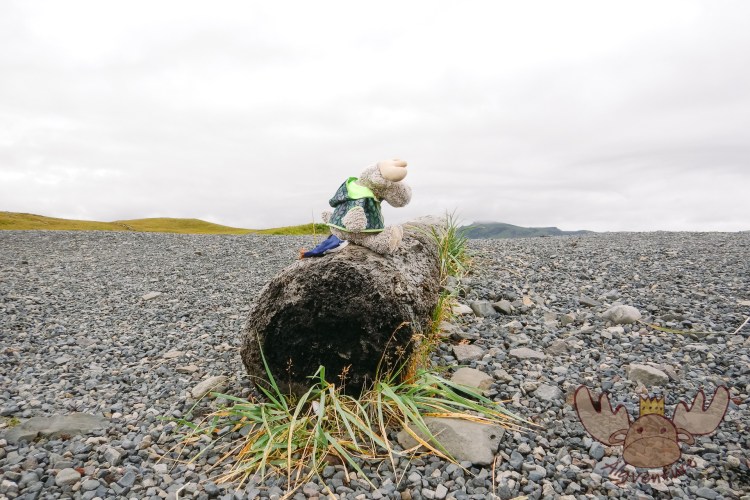
Vík í Mýrdal
How to get there?
Vík í Mýdral is located on the country’s most important road, the Hringvegur (=Ring Road) or also known as Þjóðvegur 1 (National Road). From Reyjakvík it takes around 2.5 hours or around 185 kilometers and there are other places worth seeing, museums and natural spectacles to admire along the route. Between the two destinations are, for example, the beautiful waterfalls Seljalandsfoss and Skógafoss as well as the Skógar Museum, which we recommend visiting.
Travelers arriving at the ferry port in Seyðisfjörður face a journey of over 7 hours or approximately 550 kilometers. We recommend making one or more stops here, as the journey is beautiful and, in our opinion, the glacial lake Jökulsárlón with the „Diamond Beach“ should not be missed.
Conclusion:
It has its charm precisely because the village is somewhat remote and is very small by our standards. The place is suitable for travelers who want to experience something as well as for those who want to enjoy the spectacular nature in peace.


The South of the North – A travel report
It was that time again – we were embarking on a new adventure. After our stay with the Queen in London a few weeks earlier, we were drawn out into the world again to explore it. Many blank spots on our travel map are just waiting to be discovered by us. The general direction of…


Sunset on the Dachstein – Dinner in the Austrian Alps
The Dachstein: The jewel of the Alps attracts nature lovers and adventure seekers alike. Experience the breathtaking beauty of the Alpine landscape, from rugged rock faces to glittering glaciers. Whether you are an experienced mountaineer or a leisurely hiker – the Dachstein has something for everyone. Via ferratas, summit tours or leisurely hikes: everyone will…
In search of elves and banana plantations – A trip to Iceland
Imagine standing on the edge of a gurgling geyser while steam fogs up your glasses. Or hiking through a lunar landscape of black sand, framed by snow-capped peaks. Sound like an adventure? Iceland is just that and much more!
Join me on my adventure to Denmark, Iceland and the Faroe Islands.
Christkindlesmarkt Nuremberg
Almost everyone has heard of him and many have seen him too. The Nuremberg Christmas market is one of the largest in Germany and we tell you about our visit.
One weekend, four different Christmas markets – an exploration tour through the Austrian Christmas market tradition
The Christmas season is just around the corner and the various Advent markets want to get visitors into the Christmas spirit with their offerings. We’ll take you on our exploration tour to the most diverse representatives of Austrian Christmas market culture.
Etwas ist schiefgegangen. Bitte aktualisiere die Seite und/oder versuche es erneut.
 Älgventure