
And suddenly there is water!
Älgbert Elgson

Dieser Artikel ist auch in Deutsch verfügbar.
One of the most popular stops along the Golden Circle in Iceland is the highly active hot springs area of geysers, boiling mud pots and fumaroles.
The visit is an exciting experience because there are only a few places in the world where boiling water and steam regularly shoot out of the earth.
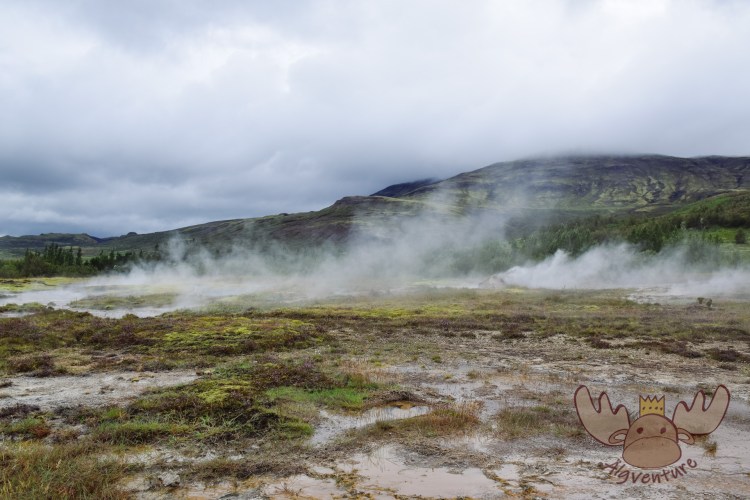
Geysir | Überall im hochaktiven Gebiet rund um die Geysire strömt Wasserdampf aus der Erde. – Water vapor flows out of the earth everywhere in the highly active area around the geysers. 
Geysir | Das Gebiet wurde vor mehr als 1.000 Jahren aktiv und besteht aus mehreren Heißwasserlöchern. – The area became active more than 1,000 years ago and consists of several hot water holes. 
Geysir | Das geothermische Feld, in dem der Große Geysir liegt, erstreckt sich über eine Fläche von etwa 3 Quadratkilometer. – The geothermal field in which the Great Geyser lies covers an area of approximately 3 square kilometers.
The trail of history
The area became active more than 1,000 years ago and consists of several hot water holes. The oldest report of the Geysir area dates back to 1294 when earthquakes in southern Iceland caused changes in the geothermal area and created several new hot springs.
Geologists believe that the geothermal field in which the Great Geyser lies extends over an area of about 3 km². Most of the active springs lie along an approximately 100 m wide strip of land that extends in the same direction as the tectonic lines in the region (south to southwest). The strip is 500 m long and culminates near what was once the seat of the Lords of Haukadalur.

Although the Great Geyser is less active today, it has lent its name to hot springs around the world. It was the first geyser to be described in a written source. Along with Old Faithful in the American Yellowstone National Park, Geysir is the most famous geyser in the world.
Reports from the 19th century mention that the Great Geyser could reach heights of up to 170 meters. The high seismic activity in the area has a strong impact on the geyser. After being inactive for years, it was revived by an earthquake in 2000 and erupted several times a day for several years. Today, Geysir is dormant again, but the other hot springs in Geysir’s geothermal area, such as Strokkur, are quite active. This spews water up to 30 meters into the air every ten minutes.
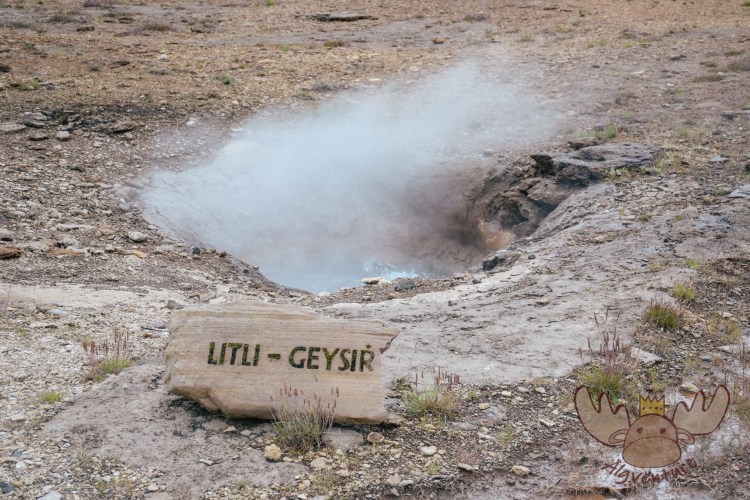
Geysir | Mehrere größere und kleinere Geysire, sowie Schlammtöpfe und Fumarolen befinden sich auf engem Raum beieinander und können vorsichtig erkundet werden. – Several larger and smaller geysers, as well as mud pots and fumaroles, are located in a small area and can be explored carefully. 
Geysir | Ein Geysir ist ein sehr fragiles Naturschauspiel und es dürfen unter keinen Umständen Gegenstände hineingeworfen werden. – A geyser is a very fragile natural phenomenon and under no circumstances should objects be thrown into it. 
Geysir | Der Große Geysir bricht leider nur in sehr langen Abständen aus. Wer also einen Ausbruch zu Gesicht bekommt, kann sich glücklich schätzen. – Unfortunately, the Great Geyser only erupts at very long intervals. So anyone who sees an eruption can consider themselves lucky.
The word geyser comes from the Old Norse word “geysa” and means something like “bubble” or “erupt”.
A geyser can only erupt if many properties occur in the same place at the same time. There must be a deep shaft that is fed by a water source. This water must be prevented from flowing away, for example by a layer of poorly permeable silica. This silica collects the water in the deep parts of the shaft, which is then heated by a heat source, such as a volcanic system, until the water begins to boil. Given enough pressure and heat, these vapor bubbles rise explosively and take a large amount of water with them on their way up. The geyser erupts.
Some geysers erupt regularly every few minutes, such as Strokkur, but for others this process takes many years.
In addition to geysers, this geothermal area also contains fumaroles and mud pots. Fumaroles are rising columns of steam and gas that flow from the underground volcanic system to the earth’s surface.
Mud pots are bubbling pools of boiling dissolved rock components. You shouldn’t get too close to these mud pots, as they are often surrounded by a very thin crust on the surface and you could easily break in here. The mud is extremely hot and can cause severe burns.

Useful information
The Geysir Visitor Center, which aims to provide not only goods but also information to visitors, is next door and includes toilets, shops, restaurants and accommodation. Depending on visitors‘ preferences, both a luxury hotel and a simple campsite are available.
Even if you would like to see the natural spectacle up close, you should keep a sufficient distance from the geysers and under no circumstances leave the marked paths. The ground could give way under its own weight and serious injuries would result.
Likewise, you should not throw objects into the geysers, mud pots and fumaroles, as they will never appear again and these objects can disrupt the natural wonders to such an extent that they would no longer spew water.
Geysir | Älgbert beobachtet in sicherer Entfernung von einem nahegelegenen Hügel aus den spektakulären Ausbruch des Strokkur. – Älgbert watches the spectacular eruption of Strokkur from a safe distance from a nearby hill. Geysir | Das geothermische Feld, in dem der Große Geysir liegt, erstreckt sich über eine Fläche von etwa 3 Quadratkilometer. – The geothermal field in which the Great Geyser lies covers an area of approximately 3 square kilometers.
If you want to avoid the biggest rush of tourists, you should arrive either outside the peak season (June-August), before 10:00 a.m. or after 4:00 p.m. Many organized tour groups come here with their coaches from Reykjavik.
With over two million visitors a year wanting to explore Iceland and only around 350,000 residents, it will still be difficult to have a place as famous as Geysir all to yourself.
How to get there?
The geyser is about 100 km from the capital Reykjavik and there are several paths that lead to the destination. The best way to witness this natural spectacle is to take a self-drive tour of the Golden Circle. This can be traveled either clockwise or counterclockwise. However, the travel time to the geothermal area of the geyser is about the same in both directions at around 1.5 hours.
In this way, the pace can be adjusted to your own needs and you have the flexibility to stop at other impressive places along the way, such as Þingvellir, Friðheimar or the many beautiful Icelandic waterfalls.
It is also possible to take a guided bus tour to the geyser. These usually start directly in the capital Reykjavik and are designed as day tours. This makes it possible for visitors to get to know the Golden Circle comfortably and quickly if they have not planned much time for exploring Iceland’s beautiful landscape.
Conclusion:
The geothermal area of Geysir should be a fixed point on the travel itinerary of every traveler to Iceland. Only a few places in the world offer such an impressive natural spectacle.


The South of the North – A travel report
It was that time again – we were embarking on a new adventure. After our stay with the Queen in London a few weeks earlier, we were drawn out into the world again to explore it. Many blank spots on our travel map are just waiting to be discovered by us. The general direction of…


Sunset on the Dachstein – Dinner in the Austrian Alps
The Dachstein: The jewel of the Alps attracts nature lovers and adventure seekers alike. Experience the breathtaking beauty of the Alpine landscape, from rugged rock faces to glittering glaciers. Whether you are an experienced mountaineer or a leisurely hiker – the Dachstein has something for everyone. Via ferratas, summit tours or leisurely hikes: everyone will…
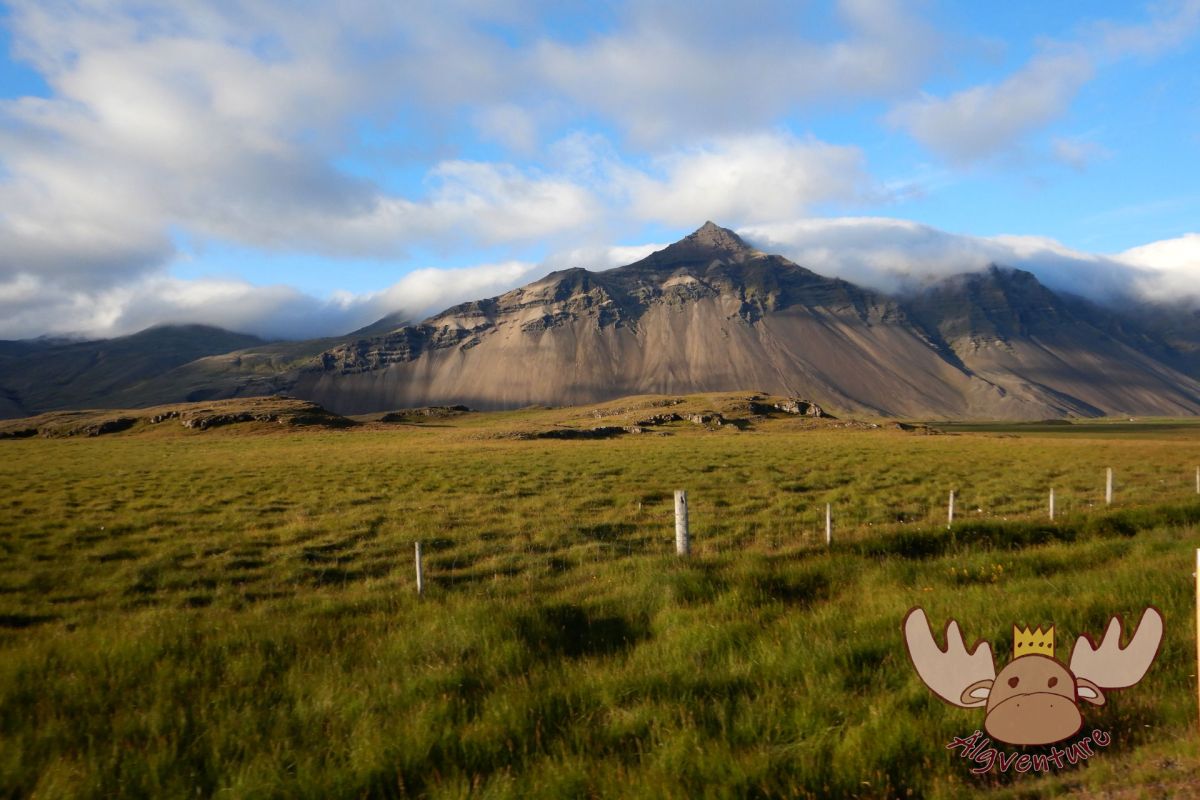
In search of elves and banana plantations – A trip to Iceland
Imagine standing on the edge of a gurgling geyser while steam fogs up your glasses. Or hiking through a lunar landscape of black sand, framed by snow-capped peaks. Sound like an adventure? Iceland is just that and much more!
Join me on my adventure to Denmark, Iceland and the Faroe Islands.
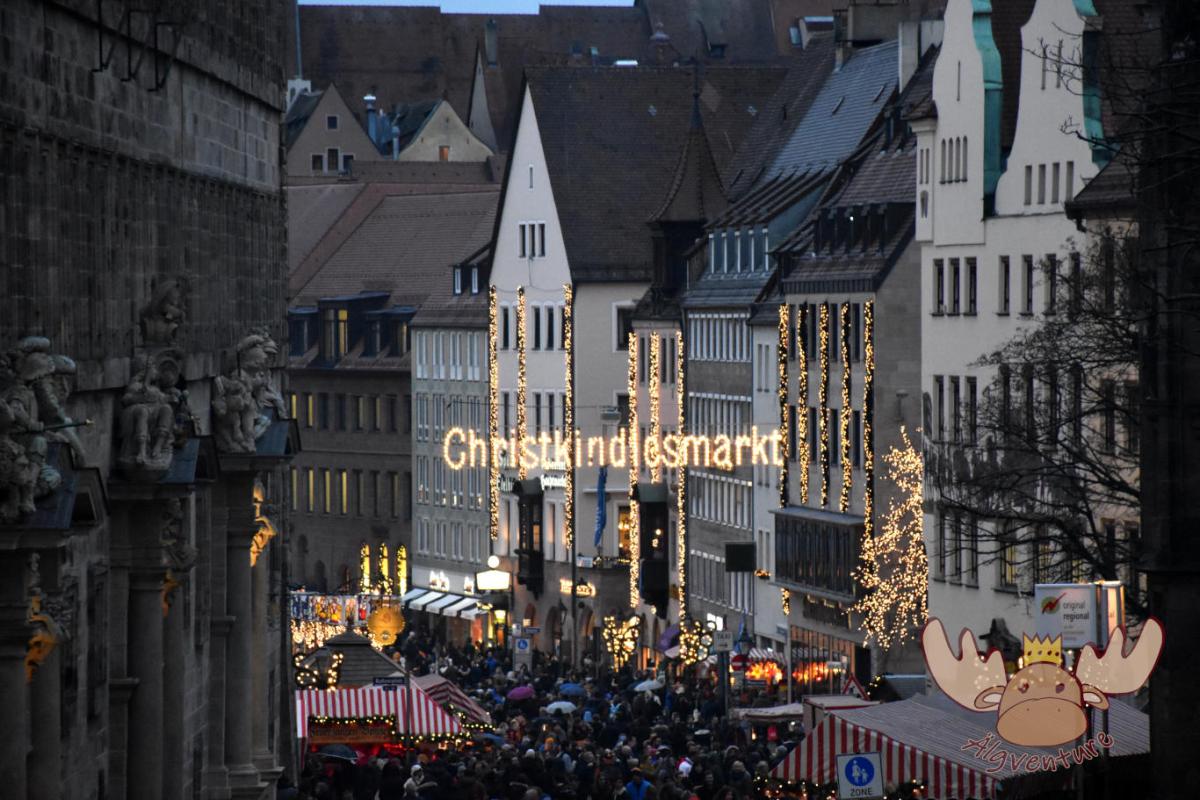
Christkindlesmarkt Nuremberg
Almost everyone has heard of him and many have seen him too. The Nuremberg Christmas market is one of the largest in Germany and we tell you about our visit.
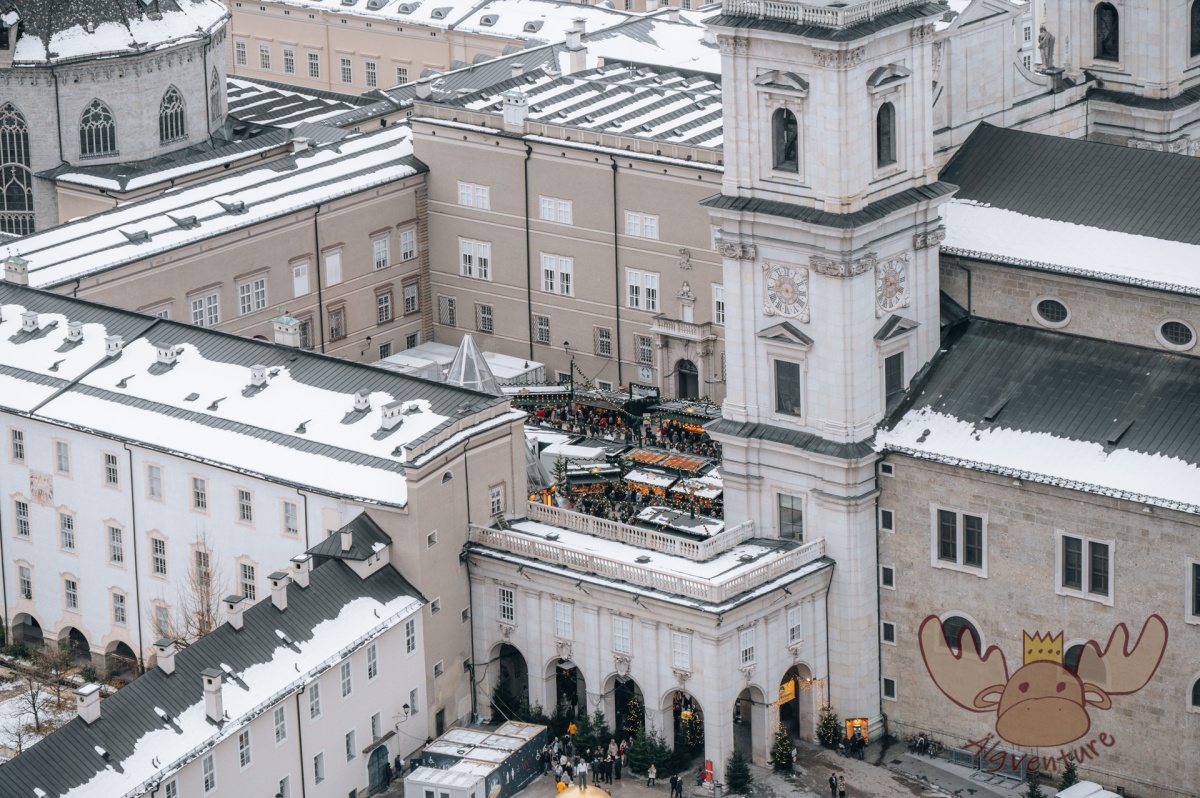
One weekend, four different Christmas markets – an exploration tour through the Austrian Christmas market tradition
The Christmas season is just around the corner and the various Advent markets want to get visitors into the Christmas spirit with their offerings. We’ll take you on our exploration tour to the most diverse representatives of Austrian Christmas market culture.
Etwas ist schiefgegangen. Bitte aktualisiere die Seite und/oder versuche es erneut.
 Älgventure