
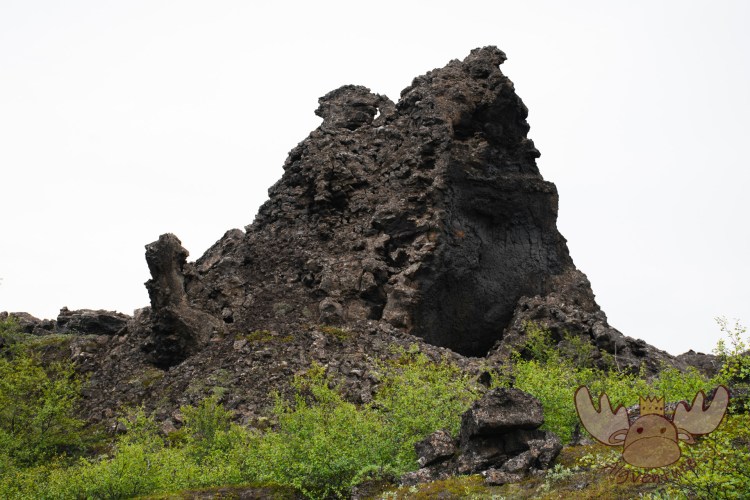
The lava formations look like dilapidated ruins.
Älgbert Elgson
Dieser Artikel ist auch in Deutsch verfügbar.
In the Dimmuborgir lava field near the Hverfjall volcano, visitors can see solidified lava formations and let their imagination run wild.
In this hiking and nature reserve, the vegetation ranges from pioneers such as lichens or mosses to dense shrubs and trees. If you walk through the seemingly unreal landscape with your eyes and ears open, you will soon realise how much it is filled with life. Most of the time you will notice it in the form of very annoying flies and mosquitoes, but from time to time birds and other animals can be spotted among the lava rocks.
The trail of history
Dimmuborgir translates as „dark castles“ and this is what comes to mind first when you see the lava formations. The bizarrely shaped rock formations of the lava field are reminiscent of ruined castles and towers.
Associated with various stories from Icelandic mythology, in which elves and trolls live in Dimmuborgir, this tourist attraction is one of Iceland’s most popular destinations. One of the folklore associated with this site declares it to be the gateway to the underworld.
This mysterious lava field, covered with irregular black lava columns and caves, originates from an eruption of the Þrengslaborgir and Lúdentsborgir crater series to the east about 2,300 years ago.

The huge lava field has been formed by steaming geothermal pools and was a small lake before the eruption, which was covered with the liquid rock. The water evaporated under the enormous heat and rose. As a result, the lava flow cooled at these points and the water vapour rose to the surface through vents up to several metres in diameter. After the crust of the lava blanket solidified, molten lava still flowed below the crust towards Lake Mývatn. The crust collapsed, but the vents and parts of the collapsed lava blanket remained. Based on the height of the vents, the depth of the lava lake can be determined to be about 10 metres.
Dimmuborgir | Dimmuborgir heißt übersetzt so viel wie „Dunkle Burgen“, denn die Lavaformationen erinnern stark an verfallene Ruinen von Burgen und Türmen. – Dimmuborgir means something like “Dark Castles” because the lava formations are strongly reminiscent of the dilapidated ruins of castles and towers. 
Dimmuborgir | Dieses geheimnisvolle Lavafeld stammt aus einer Eruption der östlich gelegenen Kraterreihen Þrengslaborgir und Lúdentsborgir vor etwa 2300 Jahren. – This mysterious lava field comes from an eruption in the eastern rows of craters Þrengslaborgir and Lúdentsborgir about 2,300 years ago. 

Dimmuborgir | Anhand der Höhe der Schlote lässt sich die Tiefe des Lava-Sees, der die Landschaft bedeckte, auf etwa 10 Meter bestimmen. – Based on the height of the lava vents, the depth of the lava lake that covered the landscape can be determined to be around 10 meters.
Useful Information
There is a large car park directly at the start of the various circular trails. These must not be left under any circumstances, on the one hand to avoid damaging nature and on the other hand to avoid breaking into a hollow and injuring yourself. The area covers about four square kilometres and is therefore large enough to get lost if you do not follow the prescribed routes.
Signs and display boards provide information about these gigantic lava formations.
Although Dimmuborgir can be visited all year round, a visit in the winter months offers a very different landscape and atmosphere than in summer. In winter, however, more care must be taken not to injure oneself due to the slippery and uneven paths.
About four kilometres away is the explosion crater Hverfjall with a height of 396 metres and a diameter of one kilometre. This makes it one of the largest explosion craters in the world.
Dimmuborgir is located on the east side of Lake Mývatn, which was also formed by a lava eruption. Lake Mývatn is home to many water birds, especially ducks. Countless vents, volcanic landforms and lava columns around Lake Mývatn provide an amazing landscape. Mývatn, which seems so peaceful, is anything but. Its location in the middle of the rift zone of the continental plates makes Mývatn a highly volcanically active area.

Dimmuborgir | In diesem Wander- und Naturschutzgebiet reicht die Vegetation von Pionieren wie Flechten oder Moosen bis zu dichtem Strauch- und Baumbewuchs. – In this hiking and nature reserve, the vegetation ranges from pioneers such as lichens and mosses to dense bushes and trees. 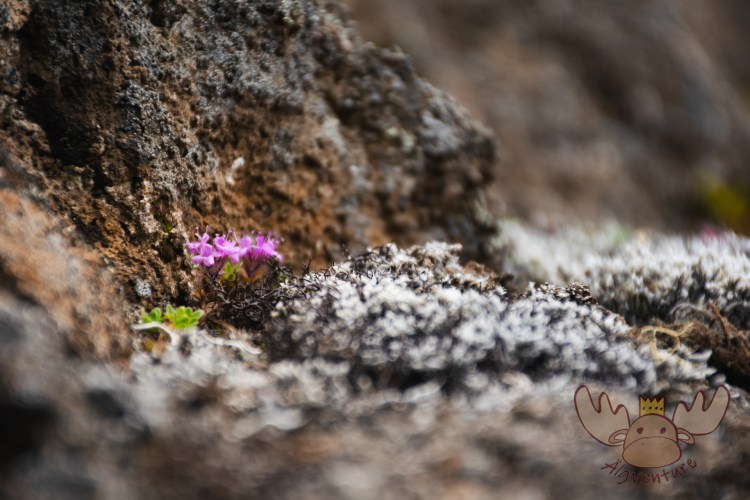
Dimmuborgir | Wer mit offenen Augen und Ohren durch die unwirklich wirkende Landschaft wandert, wird schnell merken wie sehr sie mit Leben gefüllt ist. – Anyone who wanders through the unreal landscape with open eyes and ears will quickly notice how full it is with life. 
Dimmuborgir | Gut angelegte Wanderwege ziehen sich durch das Lavafeld. – Easily accessible hiking trails run through the lava field. 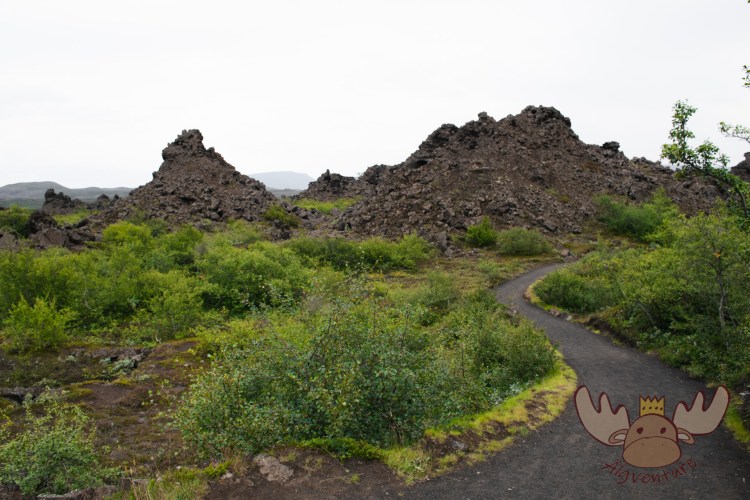
Dimmuborgir | Gut angelegte Wanderwege ziehen sich durch das Lavafeld. – Easily accessible hiking trails run through the lava field.
How to get there?
Dimmuborgir is located in the immediate neighbourhood of Lake Mývatn and is easy to reach. From Reykjavik, the distance is about 470 kilometres or a six-hour drive. However, it is highly recommended to take your time and admire the beautiful nature on the way. Coming from Reykjavík, you first drive north on Ring Road 1, through the Hvalfjarðargöng tunnel and the birch region of Borgarfjörður.
From Akureyri, it is about an one-hour drive to reach the mysterious formations of Dimmuborgir. This is also the route to reach Lake Mývatn.
Conclusion
You should definitely plan enough time for a visit to Dimmuborgir. Several trails of different lengths and difficulty levels lead through the area. In this nature reserve you can see with your own eyes how nature takes over the barren and desolate lava fields. The information boards clearly describe this process as mosses and lichens prepare the way for other plants to thrive in this landscape.


The South of the North – A travel report
It was that time again – we were embarking on a new adventure. After our stay with the Queen in London a few weeks earlier, we were drawn out into the world again to explore it. Many blank spots on our travel map are just waiting to be discovered by us. The general direction of…


Sunset on the Dachstein – Dinner in the Austrian Alps
The Dachstein: The jewel of the Alps attracts nature lovers and adventure seekers alike. Experience the breathtaking beauty of the Alpine landscape, from rugged rock faces to glittering glaciers. Whether you are an experienced mountaineer or a leisurely hiker – the Dachstein has something for everyone. Via ferratas, summit tours or leisurely hikes: everyone will…
In search of elves and banana plantations – A trip to Iceland
Imagine standing on the edge of a gurgling geyser while steam fogs up your glasses. Or hiking through a lunar landscape of black sand, framed by snow-capped peaks. Sound like an adventure? Iceland is just that and much more!
Join me on my adventure to Denmark, Iceland and the Faroe Islands.
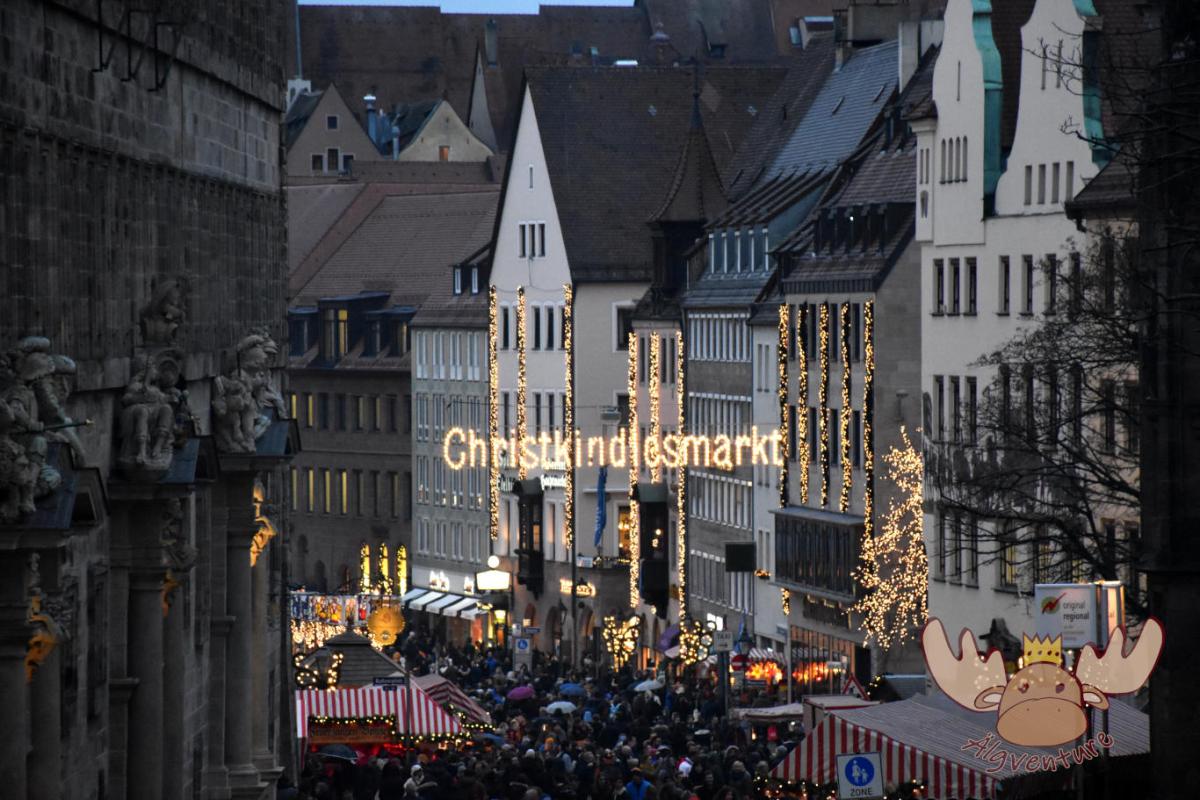
Christkindlesmarkt Nuremberg
Almost everyone has heard of him and many have seen him too. The Nuremberg Christmas market is one of the largest in Germany and we tell you about our visit.
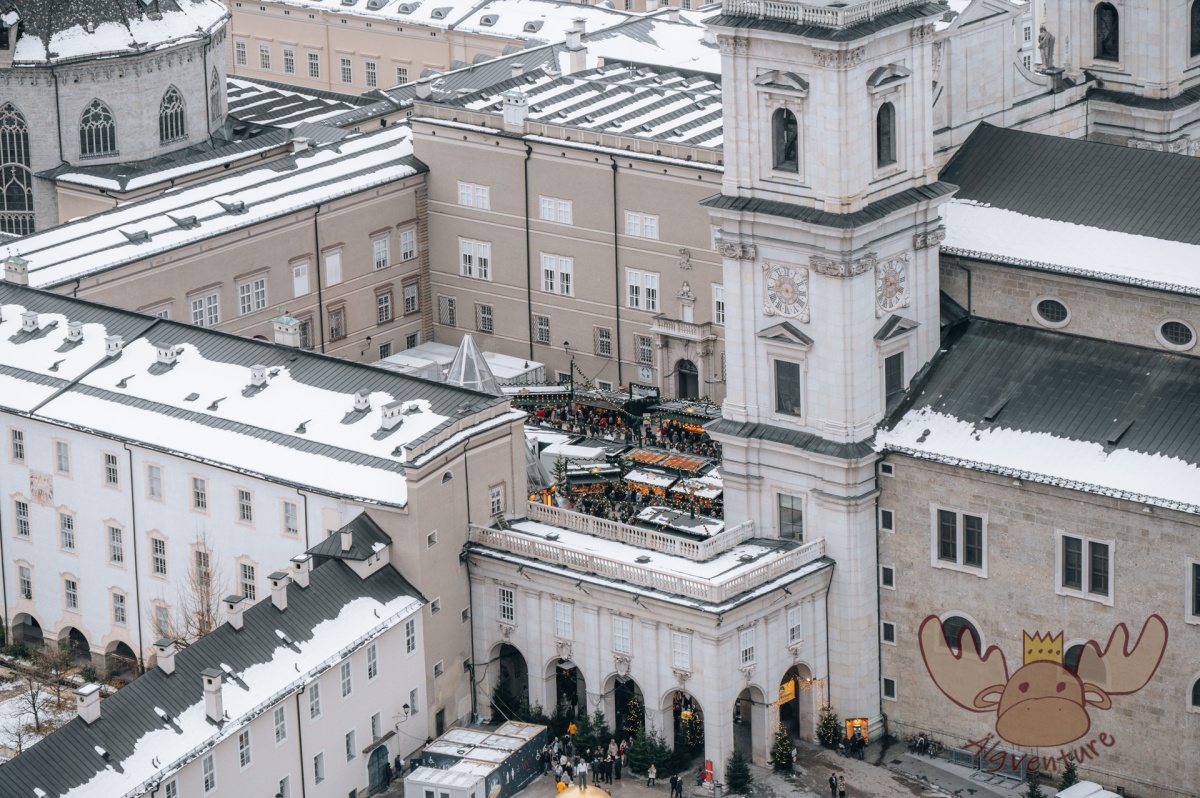
One weekend, four different Christmas markets – an exploration tour through the Austrian Christmas market tradition
The Christmas season is just around the corner and the various Advent markets want to get visitors into the Christmas spirit with their offerings. We’ll take you on our exploration tour to the most diverse representatives of Austrian Christmas market culture.
Etwas ist schiefgegangen. Bitte aktualisiere die Seite und/oder versuche es erneut.
 Älgventure